


Just parsing UAE motor policies demands attention to jargon so you can safeguard your vehicle and wallet; you must watch for hidden exclusions that can void your coverage and steep fines or uninsured liability, while also spotting valuable add-ons and clear claim procedures that protect you; this guide equips you to decode policy language, question insurers, and secure comprehensive protection aligned with your needs.

Key Takeaways:
- Know your policy type-third‑party, third‑party fire & theft, or comprehensive-and which perils, liabilities and own‑damage scenarios each actually cover.
- Scrutinize exclusions and endorsements (named drivers, modifications, wear & tear, aftermarket parts, riot or war clauses) that commonly void or limit cover.
- Verify territorial limits, GCC/overseas use and permitted drivers to avoid denied claims when driving outside the stated area or lending the vehicle.
- Understand excesses, agreed vs market value settlement, no‑claims bonus rules and the role of police reports in fault determination and claim acceptance.
- Confirm which language version governs the contract, obtain clear English translations of ambiguous clauses and consult a broker or legal adviser for complex or esoteric terms.
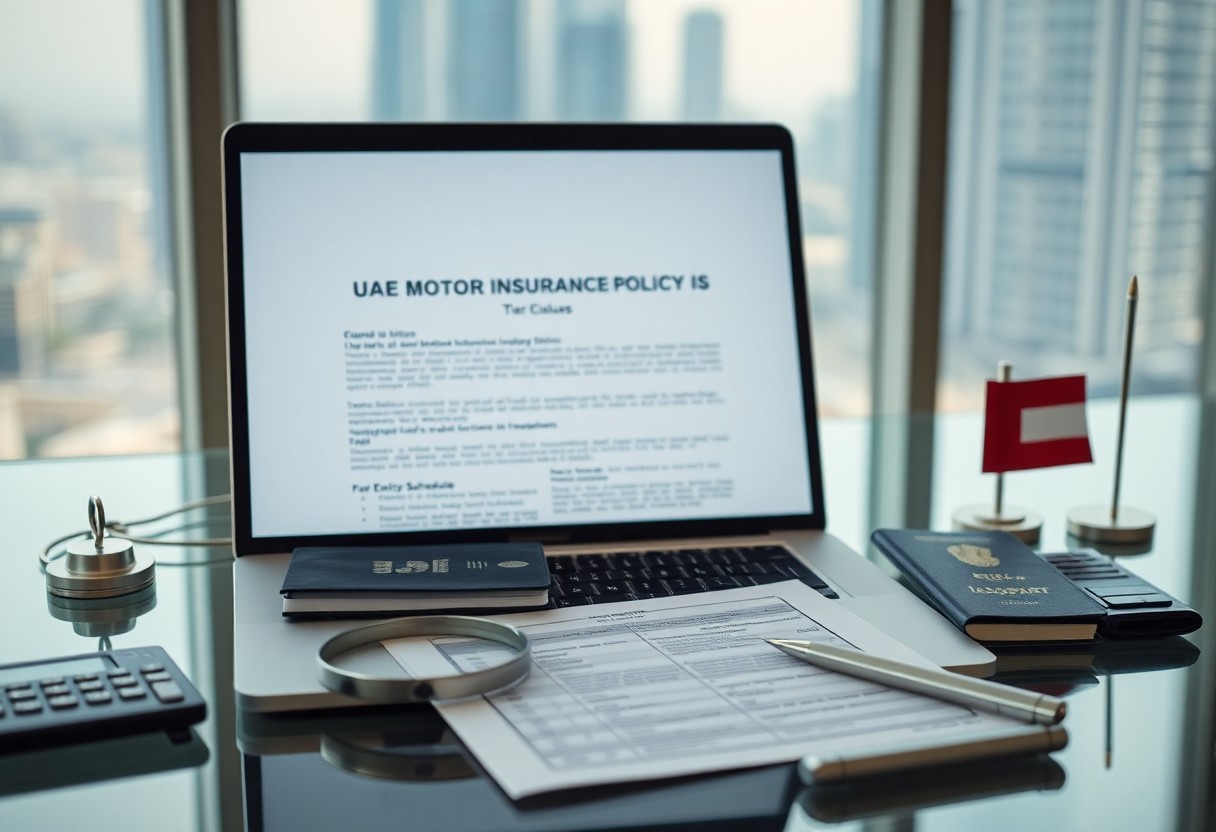
Understanding Motor Insurance in the UAE
The Basics of Motor Insurance
You must carry at least third-party liability cover in the UAE; comprehensive policies add protection for your vehicle, theft, fire and windscreen. Premiums hinge on factors like vehicle age, engine size and driving history, and insurers commonly apply an excess of AED 500-2,000 per claim. Policies offer add-ons such as roadside assistance and agency repairs, while your No Claims Discount (NCD) typically grows over 1-5 claim-free years, often reducing premiums by 20-60%.
Key Terminology in Policies
You’ll see terms like Sum Insured (market value of your car), Excess (your out-of-pocket per claim), Total Loss (when repair costs approach or exceed ~60-70% of value), Third-Party, Comprehensive, and NCD. Also note exclusions for wear-and-tear, unapproved modifications, and named-driver limits-these often determine whether a claim is paid in full or reduced.
For example, if you’re hit and the repair bill is AED 40,000 on a car valued AED 55,000, many insurers will deem it a total loss and pay market value minus salvage; your excess still applies. You should report accidents to the police and insurer within 24 hours, because delayed notification can trigger claim denial. Subrogation lets your insurer recover costs from a liable third party, but uninsured-at-fault incidents can leave you exposed unless you have specific cover.
Common Esoteric Clauses Explained
You’ll see clauses that look small but shape outcomes: voluntary excesses (typically AED 500-3,000), parts depreciation (commonly 30-50% for older components), OEM-only repairs, and named-driver limits. These govern whether a minor windscreen claim or a major engine repair gets paid, and they determine if using an approved garage or declaring aftermarket parts will swing a claim from paid to denied.
Coverage Limitations
Policies often carry sub-limits and caps: rental-car cover might be AED 100-300 per day for a set period, roadside assistance limits can restrict towing distance or number of callouts, and aggregate caps can cap third‑party property payouts per incident; if your repair estimate exceeds the sub-limit, you’ll pay the balance out of pocket.
Exclusions and Exceptions
Standard exclusions include driving under the influence, unlicensed drivers, deliberate damage, and unauthorised commercial use (e.g., ride‑hailing without endorsement); insurers routinely deny claims where policy terms were breached, so a single unlisted modification or undeclared driver can void cover.
Digging deeper, you’ll find clauses on salvage retention, subrogation rights, and mandatory use of approved workshops-if you sign a repair at an independent garage, the insurer may limit reimbursement. For example, an engine rebuild after flood damage can exceed AED 20,000; if flood or aftermarket modifications are excluded, you shoulder that entire cost despite holding a “comprehensive” policy.
The Role of Local Regulations
When you read UAE motor policies you must factor in local rules: third-party liability cover is mandatory, policy documents are commonly issued in both Arabic and English, and common deductibles range from about AED 500-5,000 depending on class and insurer. Regulators require insurers to hold solvency reserves and publish clear exclusions, so your choice of insurer affects both pricing and the speed of claims handling at RTA/police checks. Driving without valid cover is illegal and dangerous to your finances.
UAE Insurance Authority Guidelines
You’ll find the Authority enforces transparent disclosure of premiums, commissions and exclusions, mandates Arabic-language availability, and requires periodic solvency reporting and audits of carriers. It runs a consumer portal for complaints and can impose fines or license actions for non-compliance, so insurers tend to standardize wording and claims procedures. If you file a dispute, the Authority’s processes and published circulars shape timelines and evidence requirements for your claim.
Impact of Sharia Law on Insurance
You should know Sharia-compliant motor cover (Takaful) operates on risk-sharing, not conventional insurance profit models: participants pool contributions, surplus may be returned to participants, and operators charge fees (wakala) or share profits (mudaraba). Policies avoid riba and excessive uncertainty, and so investment of reserves follows Sharia board rulings. Many UAE insurers offer both options, letting you pick the structure that aligns with your preferences and claims expectations.
Example: if your annual motor contribution is AED 3,000 under a takaful plan, an illustrative split might allocate most to the participants’ risk pool while the operator retains a fee portion and any surplus is distributed back after claims-this affects net cost and potential refunds. You’ll also face slightly different documentation and governance: Sharia boards review investment of reserves and dispute resolution can involve specialist rulings, so check the operator’s wakala fee, surplus distribution rules, and sample claims settlement timelines before you buy.
Challenges Faced by Expats
You face a cluster of practical hurdles: navigating policies where third-party liability is legally mandatory, decoding dense exclusions like depreciation, and managing the No-Claim Bonus (NCB) rules that affect renewals. Insurance terminology varies between providers, and a single misread clause can lead to large out-of-pocket bills after an accident. Many expats find claims processing timeframes, documentation lists, and repair-authorisation rules unexpectedly strict compared with their home country.
Language Barriers
Policies and endorsements are often issued in both English and Arabic, and ambiguity between versions can cost you; insurers may reference the Arabic wording in disputes. You’ll encounter technical terms-like “constructive total loss” or “agreed value”-that translate poorly, while call-centre support may switch languages mid-call. Small misinterpretations have led to denied claims when policy limits or excesses weren’t clearly understood, so confirm definitions in writing before you sign.
Cultural Differences
You’ll notice informal practices-dealers or garages offering to “handle” paperwork or offer cash settlements-that don’t substitute for formal insurer endorsements. Verbal assurances from third parties often fail during claims, and settling outside insurer channels can void your cover, leaving you liable for structural or liability costs later. Adapt your expectation to insist on written approvals and insurer-issued estimates.
In practice, insurers here may treat documentation and authority differently: they often require original police reports, stamped invoices, and pre-authorisation for parts and repairs. Young drivers or recently licensed drivers can see premiums jump significantly, and some policies exclude certain vehicle modifications common in expat communities. If you’ve relied on a dealer’s “insurance included” pitch, verify the policy scope-many disputes arise because roadside promises didn’t match the written policy.
Tips for Decoding Insurance Policies
When you read a UAE motor insurance policy, scan for terms like policy exclusions, sublimit, and excess; excesses commonly range from AED 500-2,000 and sublimits for electronics or personal items can wipe out cover in a claim. Compare the comprehensive cover wording across insurers and note any time limits for filing claims (often 7-14 days). Use the insurer’s PDF wordings and contract clauses to spot differences. This gives you concrete checkpoints when evaluating quotes.
- Compare quotes from at least 4-6 insurers to expose varying sublimits.
- Check excess amounts (AED 500-2,000) and who pays them after an accident.
- Inspect exclusions such as named-driver limits, off-road use, or electronics sublimits.
Seeking Professional Advice
You should engage a licensed local broker or independent adviser who can translate Arabic legalese, highlight dangerous policy exclusions, and run scenario tests-e.g., a 2019 expat case where unclear named-driver wording led to a rejected AED 45,000 claim. Ask for a written comparison showing premiums, excesses, and sublimits; many brokers will review a policy within 48-72 hours and point out gaps in written terms.
Utilizing Online Resources
You can use insurer websites to download full PDF wordings and apply Ctrl+F searches for keywords like exclusion, sublimit, and excess, then compare at least 5 policies; industry portals and expat forums often list common pitfalls such as glass cover limits or named-driver restrictions observed in real claims, helping you avoid surprises.
Dig deeper by using boolean searches (e.g., “motor policy” AND “sublimit” site:.ae) to surface official wordings, regulator notices, and claim case studies; download sample policies and create a one-page matrix comparing premium, excess, agreed/market value, and the top three exclusions-this makes differences visible and speeds decision-making.
Case Studies of Expats
You’ll find real-world outcomes where small misreads of a clause cost thousands or where proactive steps saved policies. The examples below show how your choices on endorsements, declared drivers, and excess levels directly affected claim payouts, premium hikes, and renewal terms across different emirates.
- Case 1 – Dubai, 34-year-old Indian driver: you submitted a claim for a front-end collision; insurer cited an undeclared named driver and reduced payout from AED 28,500 to AED 12,750 (55% cut); premium rose 42% at renewal.
- Case 2 – Abu Dhabi, 29-year-old British expatriate: you chose a comprehensive plan with AED 1,000 excess, reported theft; insurer paid 100% of AED 64,200 after invoice proof and police report, no surcharge at renewal.
- Case 3 – Sharjah, 45-year-old Filipino driver: you failed to notify modification (aftermarket turbo); claim for engine damage of AED 33,400 was declined under the policy’s modification exclusion clause.
- Case 4 – Ras Al Khaimah, 26-year-old Pakistani rider: you relied on a cheap third-party policy; collision costs totaled AED 18,900 and you paid out-of-pocket because third-party cover excluded own-damage; subsequent switch to UAE motor insurance comprehensive cut future exposure by 100% for crash repairs.
- Case 5 – Dubai, 52-year-old American expat: you added a roadside assistance endorsement for AED 150 annually, used it twice; saved AED 2,300 in towing and emergency repairs, credited as a positive underwriting note on renewal.
Success Stories
You can replicate wins by documenting everything: one expat in Dubai secured a full AED 60,000 payout for total loss because they supplied time-stamped photos, repair estimates, and a police report within 48 hours; the carrier honored the comprehensive wording and paid without dispute, keeping renewal increases under 10%.
Common Pitfalls to Avoid
You should avoid leaving modifications undeclared and misreporting regular drivers, since both trigger exclusions and can lead to voided claims or steep payout reductions; small omissions have produced denials of AED 20,000-40,000 in several cases.
Delving deeper, you’ll see specific clauses that trip expats: declaring only one driver when others regularly use the car, not listing business-use when using the vehicle for deliveries, and underinsuring vehicle value to save on premium. Each misstep changes underwriting risk profiles; insurers then apply higher excesses, levy surcharges of 25-60%, or refuse liability for sections like personal effects and modifications. Your audit of policy wording and a short call to an advisor can prevent these exact outcomes.
To wrap up
So you can demystify UAE motor-insurance clauses by taking systematic steps: read the policy word-for-word, request Arabic translations or clarified definitions, consult licensed brokers or legal advisors, ask insurers for written explanations, compare policies, note exclusions and deductibles, maintain documented correspondence, and keep updated on local regulations; with due diligence and professional help you will protect your rights and avoid surprises at claim time.
FAQ
Q: Can expats realistically decode the esoteric clauses in UAE motor insurance policies?
A: Yes-many expats can understand them with the right approach. Policies use legal and insurance jargon plus occasional Arabic phrasing; the document structure (definitions, cover sections, exclusions, endorsements, schedule) is predictable. Obtain the insurer’s full policy wording (not just the summary), read the definitions first, compare the schedule to the main wording, and flag any unfamiliar terms for clarification from a broker, insurer or qualified translator. If the policy names a governing language, treat that version as authoritative and seek legal advice if there is any high-value ambiguity.
Q: Which specific clauses cause the most confusion and how do they affect coverage?
A: Frequently confusing clauses include: (1) Exclusions – e.g., unauthorized drivers, racing, driving under influence, wear-and-tear, and non-approved modifications; these remove cover even if a claim seems otherwise valid. (2) Limits and sub-limits – third-party liability caps, glass or personal-accident sub-limits restrict maximum payouts. (3) Deductibles/excess – fixed or percentage amounts the policyholder must pay per claim. (4) Valuation and depreciation – terms that determine payable amount (market value, agreed value, or depreciation schedules). (5) Territorial limits – where the policy applies (UAE only, GCC, or need additional paperwork for travel). (6) No-claim discount (NCD) conditions and transfer rules – when and how discounts apply or are lost. (7) Endorsements and riders – modifications that override parts of the base policy. Each can materially change claim outcomes; check wording and examples in the policy.
Q: Step-by-step: how should an expat decode a motor insurance policy clause by clause?
A: 1) Get the full policy wording and any endorsements in the language specified as governing. 2) Read the definitions section and list unfamiliar terms. 3) Compare the schedule (cover types, limits, deductibles) against the detailed sections. 4) Highlight all exclusions, territorial limits and driver restrictions. 5) Note claim notification time limits, documentation required, and repair/approved-garage procedures. 6) Ask the insurer/broker to explain ambiguous clauses using a hypothetical claim (they must confirm in writing). 7) If the Arabic version is governing or wording is unclear, obtain a certified translation and, for high-stakes items, a short legal review. 8) Keep written confirmations of any verbal promises and every endorsement issued after purchase.
Q: What should I do if the Arabic and English texts differ or if an insurer uses obscure Arabic phrases?
A: First, identify which language the policy says governs disputes. If English is governing, request the insurer’s authoritative English version in writing. If Arabic is governing, obtain a certified legal translation and ask an insurance lawyer to interpret key clauses. Ask the insurer to explain any Arabic terms in plain English in writing and request a written endorsement if they agree to a different interpretation. Preserve all communications and, where necessary, escalate to a licensed broker or legal adviser before buying or if a significant claim is pending.
Q: Where can expats get reliable help decoding clauses and what are typical costs or timelines?
A: Reliable resources: licensed insurance brokers (often free to expats because they work on insurer commissions), the insurer’s customer service or claims team (free clarifications and policy copies), certified translators (fixed per-page fees; 24-72 hours typical), independent insurance lawyers (hourly or fixed-fee reviews for important clauses), and experienced repair shops or approved garages (for procedural requirements). Expect basic clarifications within 24-72 hours; certified translations 1-5 days depending on urgency; a solicitor review 2-7 days and legal fees that vary widely by complexity. Always request written confirmations of any clarifications or policy changes.


0 Comments